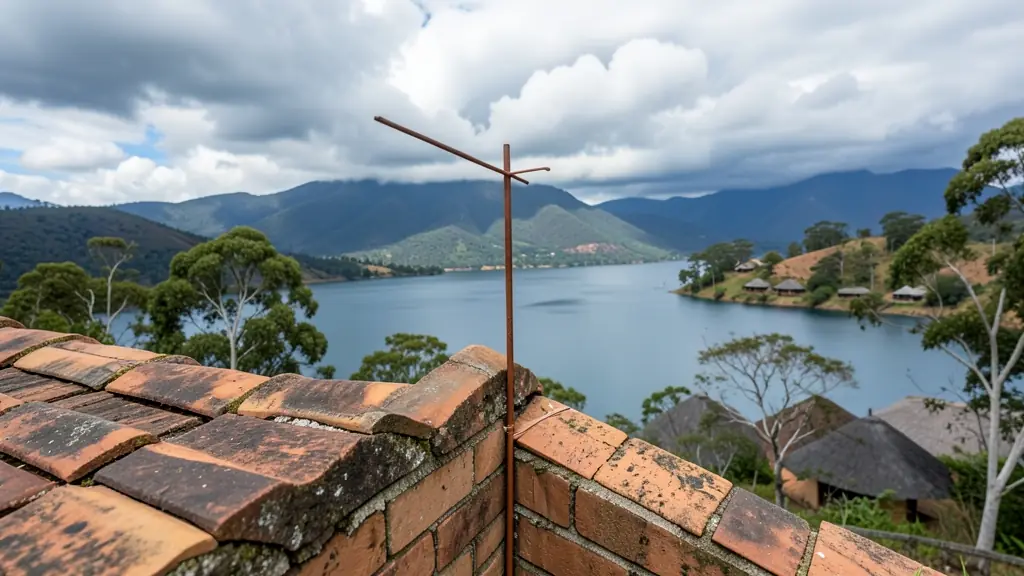
A lightning protection system is designed around the building, not bought off a shelf. Put the size, height, roof and what's inside in one request for lightning protection in Brits and we pass it to lightning protection installers working in Brits and nearby areas of North West.
Lightning Protection in Brits
Buildings in Brits that ask for lightning protection range from thatched homes and lapas to schools, churches, estates and factories. Installers who work in Brits and across North West can do a site visit, weigh up the risk, propose an external system with surge protection, and test and certify the finished installation.
The main lightning protection page explains the options, the standards and the costs in more detail.
What to know locally in Brits
Hartbeespoort's thatched roofs are the main reason people call. A good design uses free-standing masts or a wire over the ridge between masts, with a separation distance worked out by the designer, and nothing fixed into the thatch. Many older homes in Schoemansville and Kosmos have conductors run straight over the thatch, which installers often recommend replacing. Factories in Brits and pack sheds on farms need different work: risk assessments and systems for steel roofs.
Brits: the storms, the buildings and the risk
Hartbeespoort, just south of Brits, has one of the densest clusters of thatched houses in the country, and the Magaliesberg pulls summer storms right over them. Homes and guesthouses in Schoemansville, Kosmos, Meerhof and Ifafi, wedding venues on the mountain slopes and lapas beside the dam all call for isolated masts and certificates for insurers. Brits itself is a working town, with factories in the industrial area, irrigated farms along the canals and the Crocodile River, and townships at Letlhabile, Mothutlung and Oukasie where surge damage is the main worry. Installers based around Hartbeespoort know thatch well, and electricians and wholesalers in Brits cover the farms and factories.
Typical requests for lightning protection in the area come from:
- Thatched homes and lapas: isolated masts or a catenary wire keep the strike off the roof so it cannot ignite the grass
- Lodges, guest houses and venues: keeps thatched chalets, the main lodge and the boma safer through the summer storm season
- Farms and smallholdings: protects the farmhouse, sheds and borehole pumps on open ground where storms hit hard
Local tips for Brits
Asked for most in Brits: masts and catenaries for thatch at Hartbeespoort, farm pumps and factory boards. Where the suppliers are: thatch specialists around Hartbeespoort; electricians and wholesalers in Brits. A useful tip: ask the installer to show the separation distance between mast and thatch.
Lightning Protection: suits homes, thatch, estates, schools and industry. How it works: air terminal, down conductors and earth. For thatched homes and lapas, the biggest group here, that usually means isolated masts or a catenary wire keep the strike off the roof so it cannot ignite the grass. On the storm season: summer storms build along the Magaliesberg, October to March.
Service area: Brits and surrounds
Our network covers Brits together with Hartbeespoort, Letlhabile, Mothutlung, Oukasie, Damonsville, Mooinooi, Schoemansville. The building size, photos and the address help an installer work out the job and the travel before quoting.