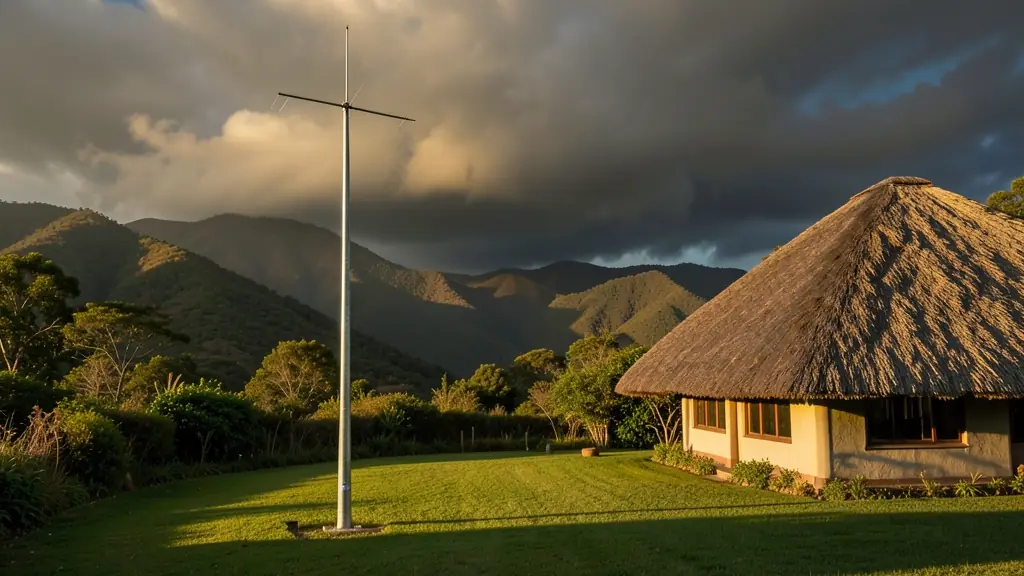
A lightning conductor pole, or lightning mast, is a free-standing pole with an air terminal on top, set in the ground beside whatever it protects. It is the usual answer for thatched houses and lodges, where nothing may be fixed to the roof, and for tanks, substations, sports facilities and open structures with no roof to carry rods. This page covers where masts are used, typical heights and finishes, guyed or self-supporting designs, footings, how the protected zone is worked out, and getting a long pole to site.
Where masts are used
- Thatch: homes, lapas, bush camps and lodge chalets, with the mast standing clear of the roof (see thatch roof lightning protection).
- Tanks and plant: fuel and chemical tanks, substations and pump stations, where an isolated system keeps current off the structure (see industrial lightning protection).
- Sports facilities: pavilions, stands and shelters, though a mast protects structures, not people standing in the open.
- Farms: silos, borehole pump houses and grain stores.
Height, finish and design
Mast height depends on what it must cover. Over thatch, masts are usually taller than the ridge so the protected zone reaches down to the eaves, and a large roof may need two or more. Most are hot-dip galvanised steel, in tapered or sectioned tubes, with a copper or stainless tip.
Shorter masts are often self-supporting on a heavy base. Taller or slender poles may use guy wires, which need space and ground anchors around the pole and should be kept out of driveways and play areas. On a long ridge, some designs string a catenary wire between two masts instead of adding a third.
Protective angle, rolling sphere and footings
The designer checks coverage with the protective angle method, which suits single masts and simple shapes, or the rolling sphere, 20 m in radius for class I up to 60 m for class IV. On thatch the mast must also stand a calculated separation distance from the roof, so a strike cannot jump across.
Self-supporting masts stand in a concrete footing or on a base plate bolted to a cast plinth, sized for the height and the wind. The down conductor runs down the pole to a test clamp and earth spikes at the base.
Delivery and installation
Long masts come in sections or on a long trailer. Sections can often travel on a bakkie; full-length poles may need a truck, and taller masts a crane or a lifting rig. Ask who digs and casts the footing, how long the concrete must cure before the mast goes up, and whether the quote includes the earth and test results. Remote lodges and farms add travel time. See lightning protection installation for the full process.
What to put in your request
- What the mast protects, with its height and size
- Ground conditions and access for a truck or crane
- Self-supporting or guyed, if you have a preference
- Number of masts, or a catenary between two
- Supply only, or a full installation
Lightning Masts and Conductor Poles for homes, thatch, estates, farms and industry
- Homeowners: a pole beside a house with a tall chimney or a roof where fixings are not wanted
- Thatched homes and lapas: one or more masts beside the thatch, set at a separation distance from the roof
- Estates and body corporates: masts for thatched clubhouses, lapas and play areas in the common property
- Offices, schools, churches and clinics: masts beside school pavilions, stands and halls where the roof cannot take rods
- Mines, plants, tanks and towers: isolated masts around fuel tanks, substations and process plant
- Farms and smallholdings: masts beside silos, pump houses and a thatched farm lapa
- Lodges, guest houses and venues: masts beside thatched chalets, the main lodge and the boma
- Solar PV owners and installers: masts beside a ground-mounted array, placed so they do not shade the panels
- Builders, engineers and electricians: mast positions and footings set out early, before landscaping and paving
Frequently asked questions
Do you supply and erect masts?
No. We are a free quote request service. We pass your request to independent mast suppliers and lightning protection installers in your area, and they quote you directly for supply, delivery or a full installation.
How tall should a lightning mast for thatch be?
There is no single figure. It depends on the roof height and footprint, the protection class and the separation distance, and many masts stand well above the ridge. Give the roof size and height in your request and the designer will work out the height and number of masts.
Can a mast protect a sports field?
A mast can protect a pavilion, stand or shelter. It does not make open ground safe for people. Fields need a warning plan, often with a lightning detector, so players are cleared before a storm arrives.
Is it safe to stand near the mast in a storm?
No. Keep well away from masts, down conductors and earth points while a storm is near, because the current spreads through the ground around the base. Go indoors and stay there until about 30 minutes after the last thunder, a common rule.
Lightning Masts and Conductor Poles by province and city
- Johannesburg
- Pretoria
- Centurion
- Midrand
- Sandton
- Randburg
- Roodepoort
- Krugersdorp
- Randfontein
- Germiston
- Boksburg
- Benoni
- Kempton Park
- Alberton
- Vanderbijlpark
- Vereeniging
- Durban
- Pinetown
- Pietermaritzburg
- Richards Bay
- Newcastle
- Ladysmith
- Gqeberha (Port Elizabeth)
- East London
- Kariega (Uitenhage)
- Mthatha
- Cape Town
- Bellville
- Paarl
- Stellenbosch
- George
- Worcester
- eMalahleni (Witbank)
- Middelburg
- Secunda
- Mbombela (Nelspruit)
- Rustenburg
- Brits
- Klerksdorp
- Potchefstroom
- Mahikeng
- Polokwane
- Tzaneen
- Kimberley
- Upington
- Bloemfontein
- Welkom
- Sasolburg