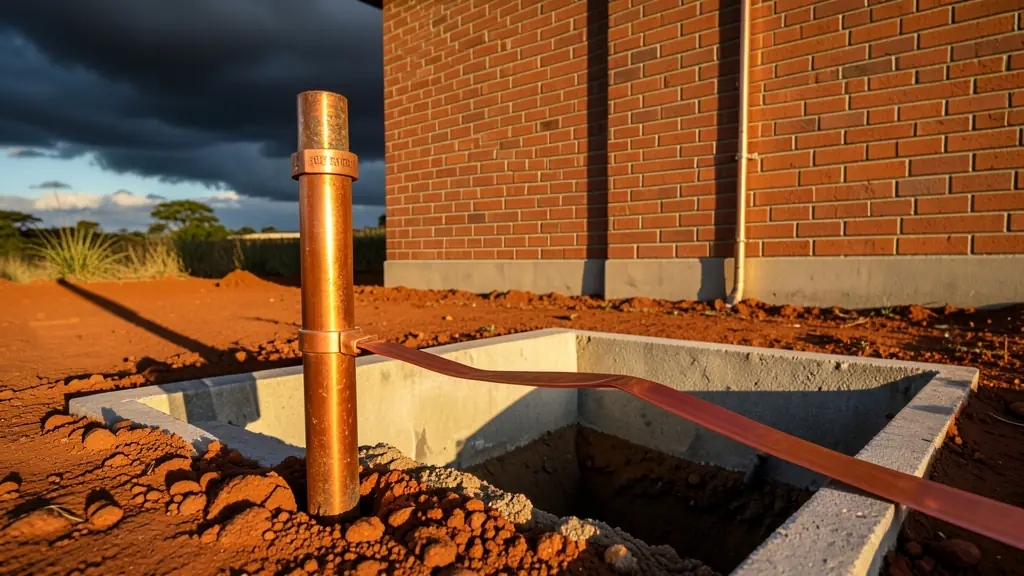
The earth termination is the part of a lightning protection system you never see, and it is the part that most often lets a system down. Earthing and lightning protection work best when they are designed and installed together: electrodes sized for the soil, conductors that join every earth on the property into one system, and readings to prove it. This page explains electrodes, rings, soil testing, bonding and how a poor earth is upgraded. Send one request and independent earthing contractors and installers in your area quote you directly.
What the earth termination does
When lightning strikes, the down conductors carry the current to the ground, and the earth termination has to spread it into the soil without dangerous voltages building up around the building. That is done with earth spikes (copper-bonded steel rods, often 1.2 m or 1.5 m long and coupled deeper where needed), earth tape or a ring conductor buried around the building, and sometimes earth plates. A common target for the lightning protection earth is below 10 ohms where the ground allows it.
Soil comes first
Soil decides how much work the earth needs. Moist clay is usually easy; dry sand, shale and rock on a Highveld ridge or in the Karoo are hard. A good contractor measures soil resistivity with a four-pole (Wenner) test before the design, then chooses the number, depth and spacing of electrodes. In poor ground, earth enhancing compound around the rods or a longer buried ring helps. See earth resistance testing for how the readings are taken.
Bonding every earth together
Many properties have several separate earths: the electrical earth at the DB board, an earth for the lightning conductor, one for the solar array, one for the gate motor and one for the phone or fibre box. Separate earths can sit at very different voltages during a strike, and that difference flashes across equipment. The standard approach is to bond them all into one earthing system with suitable conductors and clamps (see earthing materials). Bonding to the electrical installation is work for a registered electrician, who issues a CoC.
Upgrading a poor earth
Older systems often have one short rod per down conductor in dry ground, corroded clamps, or test joints that were never connected. An upgrade usually means testing what is there, adding electrodes or a ring, replacing corroded clamps, fitting inspection pits so the joints can be checked, and retesting. Ask for before and after readings in writing. On farms and lodges, where buildings are spread out and the soil is often dry, the upgrade may include buried conductors linking several buildings so they share one earth. Theft-resistant options, such as aluminium or steel in exposed places and lockable pit lids, are worth asking about.
What to put in your request
- Building size and number of down conductors, if any
- Soil type: clay, sand, shale or rock
- Existing earths: DB, solar, gate motor, telecom
- Any earth readings from a previous test
- Whether you need a CoC or a test certificate
Earthing and Lightning Protection Installation for homes, thatch, estates, farms and industry
- Homeowners: new electrodes and inspection pits at each down conductor, bonded to the DB board earth
- Thatched homes and lapas: buried conductors linking the masts around a thatched house into one low-resistance earth
- Estates and body corporates: earths at the clubhouse, gatehouse and pump station tested and joined into one system
- Offices, schools, churches and clinics: a ring conductor around a school or office, bonded to the main earth bar
- Mines, plants, tanks and towers: an earth grid for a plant or substation with every structure and tank bonded to it
- Farms and smallholdings: deeper electrodes in dry ground for the farmhouse, sheds and borehole pump
- Lodges, guest houses and venues: earth conductors run between thatched chalets so each mast shares the same earth
- Solar PV owners and installers: the array frame earth bonded to the house earth so both sit at the same voltage
- Builders, engineers and electricians: a foundation earth or ring laid before the slab is poured, with test points brought up
Frequently asked questions
Do you do the earthing work yourselves?
How many earth spikes will I need?
Is the lightning earth the same as the electrical earth?
Why does my earth reading change through the year?
Earthing and Lightning Protection Installation by province and city
- Johannesburg
- Pretoria
- Centurion
- Midrand
- Sandton
- Randburg
- Roodepoort
- Krugersdorp
- Randfontein
- Germiston
- Boksburg
- Benoni
- Kempton Park
- Alberton
- Vanderbijlpark
- Vereeniging
- Durban
- Pinetown
- Pietermaritzburg
- Richards Bay
- Newcastle
- Ladysmith
- Gqeberha (Port Elizabeth)
- East London
- Kariega (Uitenhage)
- Mthatha
- Cape Town
- Bellville
- Paarl
- Stellenbosch
- George
- Worcester
- eMalahleni (Witbank)
- Middelburg
- Secunda
- Mbombela (Nelspruit)
- Rustenburg
- Brits
- Klerksdorp
- Potchefstroom
- Mahikeng
- Polokwane
- Tzaneen
- Kimberley
- Upington
- Bloemfontein
- Welkom
- Sasolburg