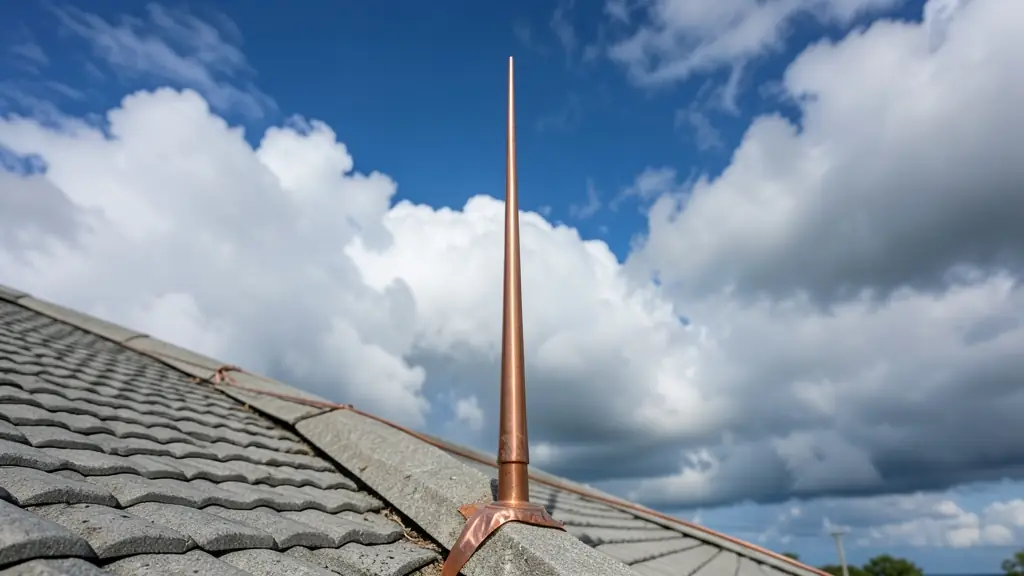
A lightning rod, which installers call an air rod, finial or air terminal, is the part of the system the strike is meant to hit. On its own it does very little. Its job is to sit where lightning would otherwise hit the roof and hand the current to down conductors and an earth. This page covers the kinds of rods and bases sold in South Africa, the metals, how high they need to be, how designers decide where they go, the claims made for special terminals, and whether to buy rods loose or as part of a designed system.
Rods, finials and bases
The common air rod is a solid round bar of copper, aluminium or steel with a plain or pointed tip. It sits on a base that suits the roof: a ridge saddle for tiles, a flat base for a concrete slab, a clamp for IBR sheeting or a parapet. Longer rods need a brace or a tripod base so wind cannot work them loose. A clamp at the foot joins the rod to a ridge conductor or down conductor.
On a tall structure or beside thatch a rod on the roof is the wrong tool, and a free-standing lightning mast does the job instead.
Copper, aluminium or stainless
- Copper conducts well and lasts, but it is the metal thieves want.
- Aluminium is lighter, cheaper and less often stolen, but must never touch copper directly. Use bimetal connectors where they meet.
- Stainless steel stands up to salt air near the coast in Durban, Gqeberha or along the West Coast.
- Galvanised steel is common for masts and longer rods.
Match the rod to the conductor metal where you can, and stick to the minimum sizes in the standard.
Height and placement
Rods go on the parts of the roof most likely to be struck: ridge ends, gable corners, chimneys and high points. Designers check coverage with the rolling sphere, an imaginary sphere 20 m in radius for class I up to 60 m for class IV, rolled over the building. Anywhere it touches needs an air terminal. Simple shapes can use the protective angle method, and flat roofs often get a conductor mesh instead of many rods.
A taller rod covers more, but adds wind load. A few well-placed short rods often beat one tall one. See lightning risk assessment for how the level is chosen.
ESE claims, and buying rods loose
Early streamer emission (ESE) and charge dissipation terminals are sold in South Africa with claims of a much larger protection zone. SANS 62305 and IEC 62305 do not recognise those claims, so ask which standard a system is designed to and what its protection zone is based on.
Electricians and installers often buy rods, bases and clamps as supplies. A homeowner is usually better served by a designed system with rods, conductors and earths quoted together: see lightning conductors.
What to put in your request
- Supply only, or supply and install
- Roof type and the number of high points
- Preferred metal: copper, aluminium or stainless
- Rod length and the type of base needed
- Delivery address, or your suburb for a site visit
Lightning Rods and Air Terminals for homes, thatch, estates, farms and industry
- Homeowners: short rods on the ridge ends and chimney of a tiled or sheeted roof
- Thatched homes and lapas: rods are never fixed to thatch; they sit on masts that stand clear of the roof
- Estates and body corporates: rods on clubhouses, water towers and guardhouses as part of a common area system
- Offices, schools, churches and clinics: rods on parapets, plant rooms and church steeples, joined to a roof mesh
- Mines, plants, tanks and towers: rods on vents, stacks, conveyors and rooftop plant, bonded to the structure
- Farms and smallholdings: rods on silos, sheds and the farmhouse, linked to earths in open ground
- Lodges, guest houses and venues: rods on brick buildings and water towers, with masts for the thatched units
- Solar PV owners and installers: rods placed to cover the array without shading the panels
- Builders, engineers and electricians: rod positions drawn on the roof plan and bases set before the roof is finished
Frequently asked questions
Do you sell lightning rods?
We don't sell anything ourselves. We pass your request to suppliers of lightning protection materials, and to installers if you want the rods fitted, and they quote you directly. Say whether you need supply only or supply and install.
How many lightning rods does a house need?
It depends on the roof shape and the protection class. A simple gable roof may need one at each end of the ridge plus one on the chimney; a hipped roof with wings needs more. The installer checks coverage with the rolling sphere or protective angle and gives you a layout.
Does a lightning rod attract lightning to the house?
It does not draw storms to your house. It gives a strike that would hit the roof anyway a better place to land and a safe path down. Without down conductors and an earth, though, a rod alone gives little protection.
Can I put a rod on a thatched roof?
No. Nothing should be fixed onto or through thatch. A thatched roof is protected with masts or a catenary wire standing clear of it: see thatch roof lightning protection.
Lightning Rods and Air Terminals by province and city
- Johannesburg
- Pretoria
- Centurion
- Midrand
- Sandton
- Randburg
- Roodepoort
- Krugersdorp
- Randfontein
- Germiston
- Boksburg
- Benoni
- Kempton Park
- Alberton
- Vanderbijlpark
- Vereeniging
- Durban
- Pinetown
- Pietermaritzburg
- Richards Bay
- Newcastle
- Ladysmith
- Gqeberha (Port Elizabeth)
- East London
- Kariega (Uitenhage)
- Mthatha
- Cape Town
- Bellville
- Paarl
- Stellenbosch
- George
- Worcester
- eMalahleni (Witbank)
- Middelburg
- Secunda
- Mbombela (Nelspruit)
- Rustenburg
- Brits
- Klerksdorp
- Potchefstroom
- Mahikeng
- Polokwane
- Tzaneen
- Kimberley
- Upington
- Bloemfontein
- Welkom
- Sasolburg