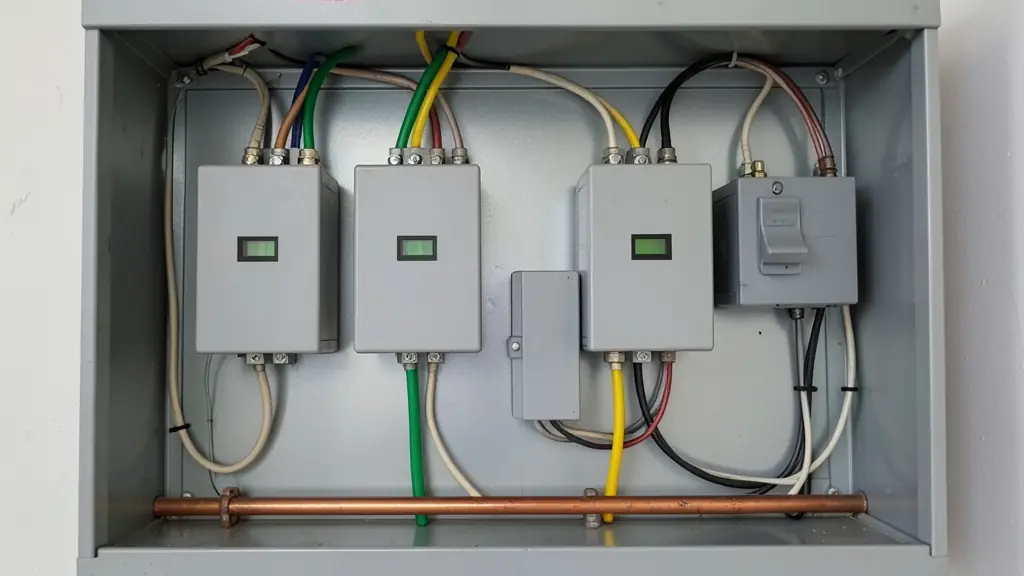
A surge arrester is a DIN-rail module in the distribution board that clamps a voltage spike and sends its current to earth before it reaches your circuits. Electricians also call it a surge protection device or SPD. Choosing one means knowing whether you need Type 1, Type 2 or a combined Type 1+2, whether the board is single or three phase, and what the ratings on the datasheet mean. This page covers that in plain terms. Send a request and independent electricians and electrical suppliers quote you directly.
Type 1, Type 2 or Type 1+2
A Type 1 arrester is tested with a 10/350 µs wave that imitates part of a direct lightning current. It belongs at the main board when the building has an external lightning conductor or is fed by an overhead line. A Type 2 arrester is tested with an 8/20 µs wave for induced surges and suits main boards without those risks and every sub-board. A combined Type 1+2 module does both jobs in one unit and is a common choice for houses and small businesses.
Reading the ratings
- Uc: the highest continuous voltage the arrester can sit at. It must suit the supply, with allowance for the high voltages some areas see.
- In and Imax (Type 2) or Iimp (Type 1): the surge current in kA it can discharge, once or repeatedly.
- Up: the voltage it lets through. Lower is better for the equipment downstream.
Ask for the maker's datasheet and compare the same figures across quotes, not the price alone.
A Type 1 device at the main board and Type 2 devices in sub-boards must work together, so the electrician chooses them as a coordinated set. Two cheap arresters from different ranges, fitted without thought to the cable length between them, can leave the second one doing all the work. Where a sub-board is more than a short distance from the main board, it usually gets its own arrester.
Single phase, three phase and backup protection
A single phase board usually needs a live and neutral arrangement; a three phase board needs protection on all three phases and neutral, which is why three phase surge protection costs more. The arrester needs a backup breaker or fuse sized to the maker's instructions, so that a device that fails short does not take out the supply. This is what people mean by a "surge arrester breaker": the arrester and its backup protection together.
Wiring and replacement
Arresters work only with short, straight leads to a good earth bar; long looped wires add voltage and undo the protection. That is work for a registered electrician, who issues a certificate of compliance under SANS 10142-1. See surge protection installation for the job itself. Many modules have a window that turns from green to red when they are spent, and plug-in cartridges can be swapped without replacing the base. Check them after every big storm.
What to put in your request
- Single phase or three phase, and the main breaker size
- Whether there is an external lightning conductor on the roof
- Overhead or underground supply into the property
- How many boards: main board and any sub-boards
- Whether you want supply only or supply and fitting
Surge Arresters for DB Boards for homes, thatch, estates, farms and industry
- Homeowners: a Type 1+2 module in the main board of a house on an overhead line
- Thatched homes and lapas: Type 1 arresters at the main board of a thatched home with a mast system
- Estates and body corporates: arresters in the clubhouse, gatehouse and pump room boards
- Offices, schools, churches and clinics: three phase arresters in the main board and Type 2 in each floor board
- Mines, plants, tanks and towers: Type 1 at the incomer and coordinated Type 2 in motor control centres
- Farms and smallholdings: arresters in the farmhouse board and the borehole pump board
- Lodges, guest houses and venues: Type 1+2 in each chalet board on long overhead runs from the main supply
- Solar PV owners and installers: AC arresters in the board that the inverter feeds
- Builders, engineers and electricians: arresters specified in board schedules for new houses and units
Frequently asked questions
Do I need Type 1 or Type 2 at home?
How long does a surge arrester last?
Can I fit a surge arrester myself?
Do you sell or fit surge arresters yourselves?
Surge Arresters for DB Boards by province and city
- Johannesburg
- Pretoria
- Centurion
- Midrand
- Sandton
- Randburg
- Roodepoort
- Krugersdorp
- Randfontein
- Germiston
- Boksburg
- Benoni
- Kempton Park
- Alberton
- Vanderbijlpark
- Vereeniging
- Durban
- Pinetown
- Pietermaritzburg
- Richards Bay
- Newcastle
- Ladysmith
- Gqeberha (Port Elizabeth)
- East London
- Kariega (Uitenhage)
- Mthatha
- Cape Town
- Bellville
- Paarl
- Stellenbosch
- George
- Worcester
- eMalahleni (Witbank)
- Middelburg
- Secunda
- Mbombela (Nelspruit)
- Rustenburg
- Brits
- Klerksdorp
- Potchefstroom
- Mahikeng
- Polokwane
- Tzaneen
- Kimberley
- Upington
- Bloemfontein
- Welkom
- Sasolburg