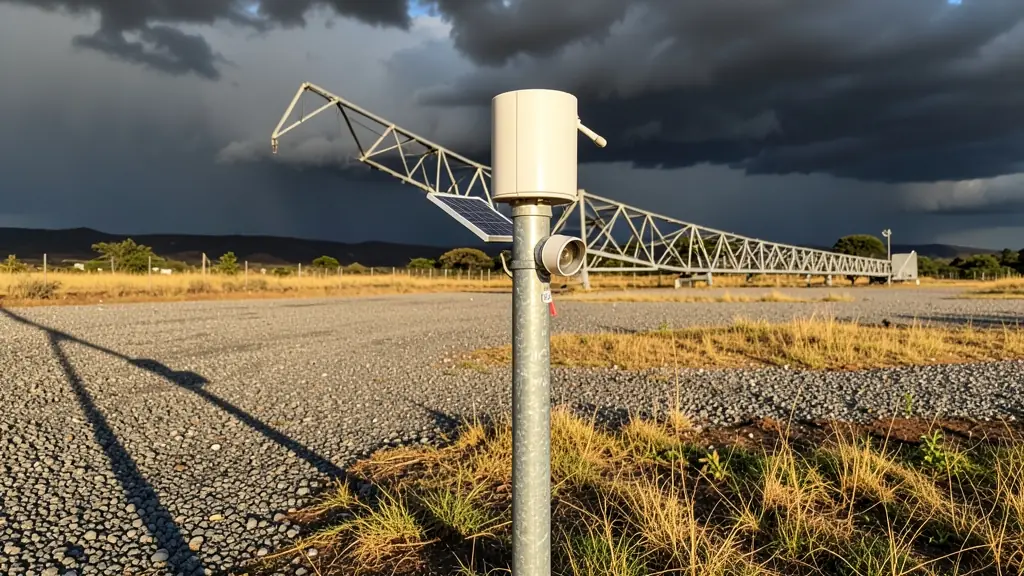
A lightning detector warns you that a storm is building or approaching, so you can get people off open ground before the first strike nearby. It does not protect a building or stop lightning: it buys time. Mines, quarries, schools, golf courses, construction sites, farms and outdoor events use them because people in the open are the ones most at risk. This page explains the main types, where they are used and how a warning fits into a safety plan. Send a request and independent suppliers and installers quote you directly.
Field mills and flash detectors
- Electric field mills measure the charge building up in the atmosphere overhead. They can raise a warning before the first flash, which matters when a storm forms right above you.
- Flash detectors sense the radio and light signals from strikes and estimate their distance, tracking a storm as it approaches.
- Handheld units suit a farmer, a coach or a site manager on the move.
Fixed systems often combine sensors and drive alarms, sirens, strobes or messages to phones.
Where detectors are used
Open-cast mines, quarries and explosives magazines stop blasting and clear pits. Schools and sports fields call children in. Golf courses sound a siren to clear the course. Construction sites stop crane and roof work. Outdoor events, farms with workers in the fields and fuel depots use warnings in the same way. Sites with tanks or hazardous areas usually combine detection with industrial lightning protection.
A warning needs a plan
A detector is only as good as what people do when it sounds. Decide in advance who calls the warning, where people go (a substantial building or a closed metal-roofed vehicle, not a tree, a tent or an open shelter), and when it is safe to return. A common rule is to wait about 30 minutes after the last thunder. Keep people away from masts and down conductors during a storm, and never work on a roof or a lightning protection system while one is active.
Apps, the national network and fixed systems
The South African Weather Service runs a national lightning detection network, and weather apps show recent strikes. These help with general awareness, but a site with many people outdoors usually needs its own sensor and alarm, which work when the cellphone signal does not. A detector complements, never replaces, lightning protection on buildings.
When you compare quotes, ask how the system decides when to warn and when to give the all clear, how far away it starts tracking storms, what happens during a power failure or load shedding, and who services the sensor. A sensor on a pole needs a clear spot, away from tall trees and buildings, and its own protection from surges. Ask too whether the supplier will help write the site's warning procedure, since that is where most of the safety comes from.
What to put in your request
- The type of site: mine, school, golf course, event, farm
- The area to cover and how many people are outdoors
- Fixed system, handheld unit or both
- Alarm wanted: siren, strobe, phone messages
- Power available on site, or solar for the sensor
Lightning Detectors and Warning Systems for homes, thatch, estates, farms and industry
- Homeowners: a handheld unit for a family that spends time outdoors on a smallholding
- Thatched homes and lapas: an early warning for guests at a thatched venue with outdoor areas
- Estates and body corporates: a siren to clear the golf course, pools and sports fields
- Offices, schools, churches and clinics: a fixed detector that calls children in from school sports fields
- Mines, plants, tanks and towers: field mills that stop blasting and clear open pits at a mine
- Farms and smallholdings: a warning to call workers in from the fields and the dairy yard
- Lodges, guest houses and venues: a warning before game drives and walks go out in the afternoon
- Solar PV owners and installers: a warning for crews on a large ground-mounted solar build
- Builders, engineers and electricians: a detector that stops crane and roof work on a construction site
Frequently asked questions
Does a lightning detector protect a building?
How far away can a detector sense lightning?
Is a phone app good enough for a school or golf course?
Do you sell or install lightning detectors?
Lightning Detectors and Warning Systems by province and city
- Johannesburg
- Pretoria
- Centurion
- Midrand
- Sandton
- Randburg
- Roodepoort
- Krugersdorp
- Randfontein
- Germiston
- Boksburg
- Benoni
- Kempton Park
- Alberton
- Vanderbijlpark
- Vereeniging
- Durban
- Pinetown
- Pietermaritzburg
- Richards Bay
- Newcastle
- Ladysmith
- Gqeberha (Port Elizabeth)
- East London
- Kariega (Uitenhage)
- Mthatha
- Cape Town
- Bellville
- Paarl
- Stellenbosch
- George
- Worcester
- eMalahleni (Witbank)
- Middelburg
- Secunda
- Mbombela (Nelspruit)
- Rustenburg
- Brits
- Klerksdorp
- Potchefstroom
- Mahikeng
- Polokwane
- Tzaneen
- Kimberley
- Upington
- Bloemfontein
- Welkom
- Sasolburg