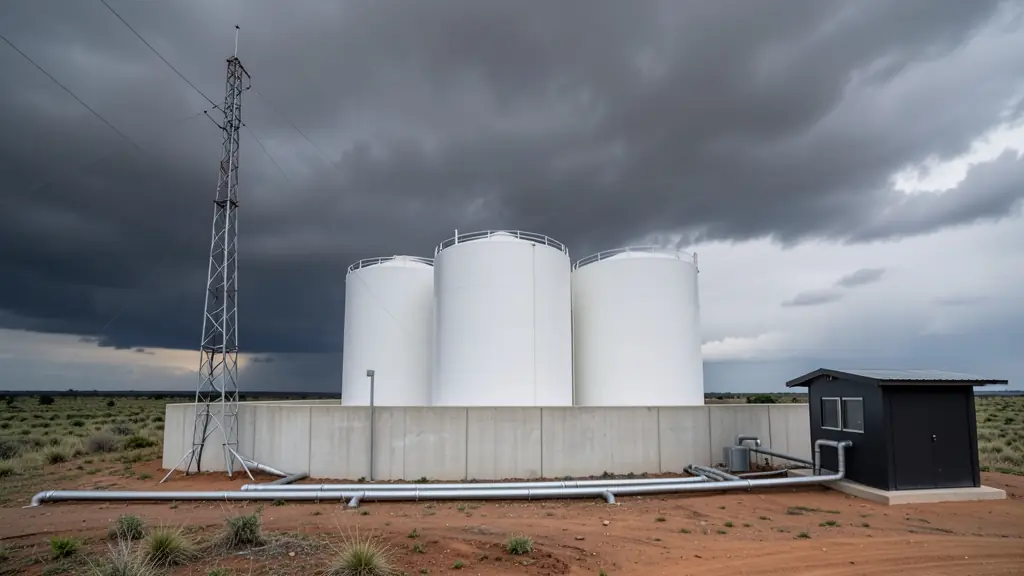
On an industrial site, lightning is a fire, explosion and downtime risk all at once. Lightning protection for tanks, hazardous areas, substations, mines, telecom towers and plants starts with a formal risk assessment and ends with a system that is bonded, earthed and surge protected throughout, then inspected on a schedule. This page explains how these sites are approached, what makes them different from a house or office, and what to ask for. Send one request and independent lightning protection engineers and specialist installers quote you directly.
Start with a formal assessment
Industrial sites are where the SANS 62305-2 risk assessment earns its keep. The engineer looks at ground flash density, the size and height of structures, flammable or explosive atmospheres, the people on site, the cost of downtime and any effect on the public or environment. The result sets the protection level and the measures for each area, from the tank farm to the control room, and should be read alongside the site's hazardous area classification. It also lists the services entering each structure, because long cables between buildings on a large site carry surges from one area to another.
Tanks and hazardous areas
For fuel and chemical tanks, the aim is to stop a strike or a spark reaching vapour. Depending on the design, that may mean isolated air terminals such as free-standing masts or catenary wires that keep the strike away from vents, or using the tank shell where it is thick enough and properly bonded. Bonding is critical: tank shells, floating roof seals, pipework, walkways and loading points are joined into one earthing system so no sparks jump between them. Hazardous areas need equipment and methods suited to the zone. Loading bays and road tanker points need bonding as well, because static and lightning both look for the easiest path to earth.
Substations, towers, mines and plants
- Substations: shield wires or masts over the yard and an earth grid under it.
- Telecom towers and data centres: tower earthing, bonding at the cable entry and surge devices on power and data.
- Mines and plants: headgears, conveyors, silos, stacks and high-mast lighting, with lightning detection to clear open areas before a storm.
- Control and instrument lines: surge devices on PLC, instrument and communication circuits, where much costly damage occurs.
Inspection regimes
Industrial systems sit in harsh conditions: corrosion, vibration, dust and constant plant changes. SANS 62305-3 sets shorter inspection intervals for stricter levels and critical systems, and many sites build testing into the maintenance plan with readings tracked from year to year. Ask for earth resistance and continuity readings at every test point and a report that flags changes since the last visit. Inspect again after any plant modification that touches structures, pipework or cable routes.
What to put in your request
- Type of site and the main structures on it
- Tanks, vents and hazardous areas, with zones if known
- Existing lightning protection and earthing
- Control, instrument and data systems to protect
- Shutdown windows and site safety requirements
Industrial Lightning Protection for homes, thatch, estates, farms and industry
- Homeowners: rarely needed, though a home beside a depot may want surge protection on its supply
- Thatched homes and lapas: thatched site offices or canteens on a mine given isolated masts like any thatched roof
- Estates and body corporates: a substation or pump station serving an estate protected and bonded to its earth grid
- Offices, schools, churches and clinics: a data centre or telecom room with bonded cable entries and surge devices on every line
- Mines, plants, tanks and towers: tank farms, substations, conveyors and control rooms covered by one assessed design
- Farms and smallholdings: a diesel tank, silos and a packhouse on open ground bonded and protected
- Lodges, guest houses and venues: a fuel store and generator room at a remote lodge given masts and bonding
- Solar PV owners and installers: a ground-mounted solar plant with air terminals, an earth grid and DC surge devices
- Builders, engineers and electricians: lightning protection designed into a new plant at drawing stage with an engineer
Frequently asked questions
Do you design or install industrial lightning protection yourselves?
Does a steel tank need extra lightning protection?
Who should design protection for a hazardous area?
Can lightning protection be added to a running plant?
Industrial Lightning Protection by province and city
- Johannesburg
- Pretoria
- Centurion
- Midrand
- Sandton
- Randburg
- Roodepoort
- Krugersdorp
- Randfontein
- Germiston
- Boksburg
- Benoni
- Kempton Park
- Alberton
- Vanderbijlpark
- Vereeniging
- Durban
- Pinetown
- Pietermaritzburg
- Richards Bay
- Newcastle
- Ladysmith
- Gqeberha (Port Elizabeth)
- East London
- Kariega (Uitenhage)
- Mthatha
- Cape Town
- Bellville
- Paarl
- Stellenbosch
- George
- Worcester
- eMalahleni (Witbank)
- Middelburg
- Secunda
- Mbombela (Nelspruit)
- Rustenburg
- Brits
- Klerksdorp
- Potchefstroom
- Mahikeng
- Polokwane
- Tzaneen
- Kimberley
- Upington
- Bloemfontein
- Welkom
- Sasolburg