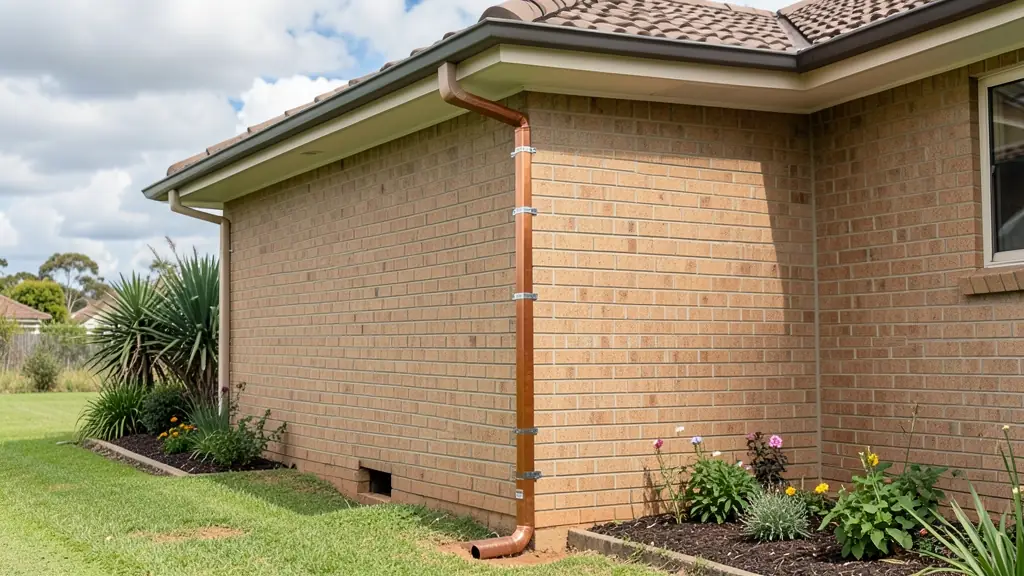
Lightning protection cable is the conductor that runs from the air rods on the roof down the outside of the building to the earth electrodes. Installers call the vertical runs down conductors. They come as flat tape or round conductor, in copper, tinned copper, aluminium or steel, and the way they are fixed and routed matters as much as the material. This page covers sizes, fixings for brick, tile and steel roofs, test joints, theft and how to work out the metres. Send a request and independent suppliers and installers quote you directly.
Tape or round, copper or aluminium
- Copper tape, 25 x 3 mm: a common size, neat on brick walls.
- 8 mm round conductor: copper or aluminium, flexible to bend around roof details.
- Tinned copper: for corrosive coastal and industrial air.
- Aluminium: lighter and less attractive to thieves, but it must not touch copper or be buried in soil or fresh mortar.
The standard sets minimum cross sections for each material, so ask the designer or supplier to confirm the size meets it. That answers the common question about lightning protection wire size.
How many and how they run
A building needs at least two down conductors, spaced around the perimeter. Typical spacing is 10 m for protection classes I and II, 15 m for class III and 20 m for class IV. The route should be short and straight, avoiding sharp bends and loops, and kept away from windows, doors and places people stand in a storm. On a thatched roof, conductors are never fixed to the thatch: see thatch roof lightning protection.
Clips, test joints and guards
Conductors are held with clips at regular spacing, with fixings that suit the surface: brick, plaster, roof tiles, IBR or corrugated sheeting, concrete parapets. Joints should be few and mechanically sound. Each down conductor gets a test joint near the ground so it can be disconnected from the earth for testing, and a guard over the lowest couple of metres protects it from damage and makes theft harder. Joints into the ground go to earth spikes or a ring.
Working out quantities
Quantity surveyors price a run in metres: roof conductors along ridges and edges, plus each down conductor from roof to test joint, plus the earth link. Add for bends and fixings. A structure plan helps, and our risk assessment and design page explains how the layout is worked out.
For a simple double storey, a rough figure is the length of the ridge and roof edges that need conductors, plus the height of each wall run times the number of down conductors, plus a few metres per earth link. Ask the supplier to quote clips, test joints and guards in the same order, and allow a little extra for offcuts. Where theft is likely, ask for prices on aluminium as well as copper so you can compare.
What to put in your request
- Building height and perimeter, or a plan
- Wall and roof type: brick, plaster, tile, IBR, concrete
- Material: copper tape, round copper, aluminium, tinned
- Metres needed, if known, and number of down conductors
- Supply only or supply and installation
Down Conductors and Conductor Tape for homes, thatch, estates, farms and industry
- Homeowners: two or more down conductors on the corners of a double storey
- Thatched homes and lapas: conductors from free-standing masts or catenaries, never touching the thatch
- Estates and body corporates: down conductors on clubhouses, water towers and sectional title blocks
- Offices, schools, churches and clinics: spaced down conductors around schools, churches and office blocks
- Mines, plants, tanks and towers: conductors on warehouses, silos and plant buildings, often aluminium
- Farms and smallholdings: down conductors on sheds, silos and the farmhouse gable
- Lodges, guest houses and venues: conductors from masts beside chalets and the main lodge
- Solar PV owners and installers: conductors from air rods near an array, kept at a safe separation
- Builders, engineers and electricians: metres of tape and conductor in the BOQ for a new building
Frequently asked questions
Can I use ordinary electrical cable as a down conductor?
Why is aluminium used when copper conducts better?
Can a down conductor run inside the wall?
Do you sell down conductor tape or install it?
Down Conductors and Conductor Tape by province and city
- Johannesburg
- Pretoria
- Centurion
- Midrand
- Sandton
- Randburg
- Roodepoort
- Krugersdorp
- Randfontein
- Germiston
- Boksburg
- Benoni
- Kempton Park
- Alberton
- Vanderbijlpark
- Vereeniging
- Durban
- Pinetown
- Pietermaritzburg
- Richards Bay
- Newcastle
- Ladysmith
- Gqeberha (Port Elizabeth)
- East London
- Kariega (Uitenhage)
- Mthatha
- Cape Town
- Bellville
- Paarl
- Stellenbosch
- George
- Worcester
- eMalahleni (Witbank)
- Middelburg
- Secunda
- Mbombela (Nelspruit)
- Rustenburg
- Brits
- Klerksdorp
- Potchefstroom
- Mahikeng
- Polokwane
- Tzaneen
- Kimberley
- Upington
- Bloemfontein
- Welkom
- Sasolburg