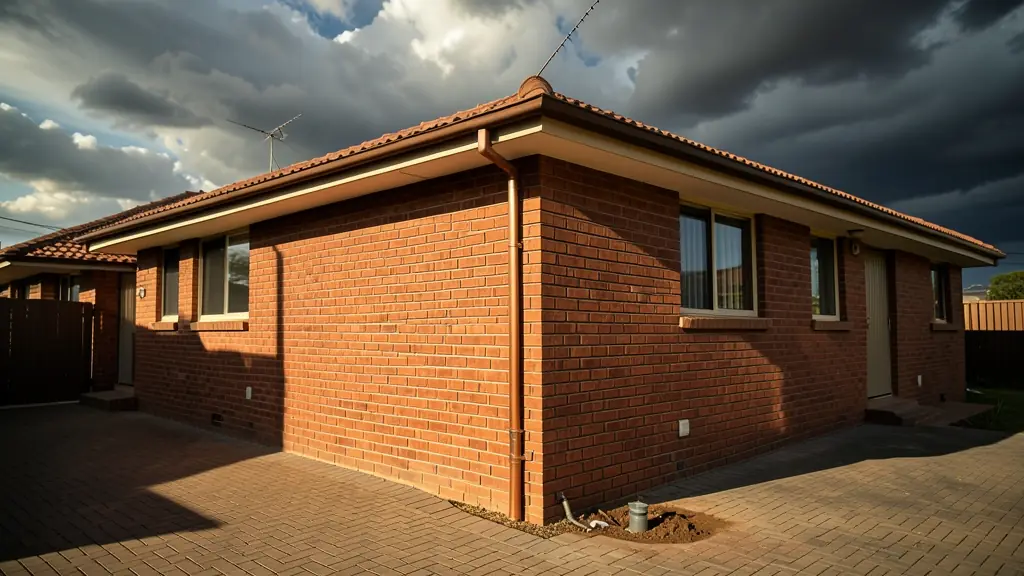
In South Africa most people call the whole system a lightning conductor: the rod on the roof, the copper strip down the wall and the spike in the ground. That is roughly right, and each part matters. A rod without a good earth, or a single conductor tacked along a gutter, can do more harm than good. This page explains what a proper lightning conductor on a house includes, how many down conductors a typical home needs, what pushes the price up or down, and what paperwork you should get at the end.
What a lightning conductor includes
A complete system starts with an air termination at the high points of the roof: usually short lightning rods or finials on the ridge and gable ends, sometimes joined by a ridge conductor. Down conductors, often 25 x 3 mm copper tape or 8 mm round conductor, carry the current down the outside walls, fixed with clips at regular spacing. A test clamp near the ground lets the installer disconnect each run for testing.
At the bottom, each down conductor meets an earth electrode, and the earths are bonded to each other and to the house's electrical earth so the whole property sits at one potential.
How many down conductors a house needs
Every building needs at least two down conductors, ideally at opposite corners, so the current splits. Larger homes need more: the standard spaces them roughly 10 to 20 m apart around the perimeter, depending on the protection class. An average single storey house often ends up with two to four, and a big double storey or a house with wings with more.
Routes should be short and straight, kept away from doors, windows and places people lean, with no sharp bends or loops. Thatch is handled differently, with masts that stand clear of the roof: see thatch roof lightning protection.
What drives the price
- Height: a double storey or steep roof needs scaffolding or ladder work and more conductor.
- Roof type: tile, IBR sheeting, slate and flat concrete each need different fixings.
- Soil: rocky or dry ground on Highveld ridges may need deeper rods, more of them or earth enhancing compound.
- Materials: copper costs more and is stolen more; aluminium is cheaper but cannot touch copper directly.
- Travel and access: farms and lodges far from town cost more to reach.
Surge protection at the DB board is often quoted alongside: see surge arresters.
The certificate at the end
Ask for continuity and earth resistance results and a written certificate. A common target for the lightning earth is below 10 ohms where the soil allows. Many insurers ask for this paperwork, especially for thatch, and it often comes up when a house is sold. Ask whether the installer is accredited through ELPA and which standard the system follows. Once installed, book regular inspections, since copper theft and roof work often break the run without anyone noticing.
What to put in your request
- House size, number of storeys and roof type
- Corners and gables, and any chimneys or aerials
- A rough idea of the soil: rocky, clay or sandy
- Whether you want copper or a theft-resistant metal
- Whether your insurer needs a certificate
Lightning Conductors for homes, thatch, estates, farms and industry
- Homeowners: the everyday system for a house: rods on the ridge, tape down two corners, earths at the bottom
- Thatched homes and lapas: for thatch the conductor runs on separate masts, never fixed onto or through the grass
- Estates and body corporates: conductors on clubhouses, guardhouses and tall units, specified by the body corporate
- Offices, schools, churches and clinics: conductors on halls, churches and school blocks, with more down runs for long walls
- Mines, plants, tanks and towers: conductors on workshops and stores, bonded into the plant's earthing system
- Farms and smallholdings: a conductor on the farmhouse and sheds, with earths that cope with dry or rocky ground
- Lodges, guest houses and venues: conductors on brick buildings and masts for thatched units across the property
- Solar PV owners and installers: conductor layout planned around the array so panels and rails stay out of the strike path
- Builders, engineers and electricians: conductor routes and earth points built into the plans and fixed before plaster and paint
Frequently asked questions
Will you fit the lightning conductor for me?
No, we don't install anything. We are a free quote request service: we send your request to independent lightning conductor installers and electricians near you, and they quote you directly.
Can I fit a lightning conductor myself?
It is not a sensible DIY job. Getting the air terminal positions, conductor routes, separation from wiring and the earth right takes design and testing, and an untested system won't get a certificate your insurer will accept. Anything wired into the DB board needs a registered electrician.
Does one rod on the roof protect the whole house?
Usually not. A single rod protects a limited zone, and long roofs, gables and chimneys outside that zone stay exposed. One down conductor also means all the current runs down one wall. Most houses need several air terminals and at least two down conductors.
Do I still need surge protection?
Yes. A lightning conductor deals with a direct strike on the house. Surges coming in on the power line, phone or fibre line, TV aerial and gate motor cable need surge protection. The two work together.
Lightning Conductors by province and city
- Johannesburg
- Pretoria
- Centurion
- Midrand
- Sandton
- Randburg
- Roodepoort
- Krugersdorp
- Randfontein
- Germiston
- Boksburg
- Benoni
- Kempton Park
- Alberton
- Vanderbijlpark
- Vereeniging
- Durban
- Pinetown
- Pietermaritzburg
- Richards Bay
- Newcastle
- Ladysmith
- Gqeberha (Port Elizabeth)
- East London
- Kariega (Uitenhage)
- Mthatha
- Cape Town
- Bellville
- Paarl
- Stellenbosch
- George
- Worcester
- eMalahleni (Witbank)
- Middelburg
- Secunda
- Mbombela (Nelspruit)
- Rustenburg
- Brits
- Klerksdorp
- Potchefstroom
- Mahikeng
- Polokwane
- Tzaneen
- Kimberley
- Upington
- Bloemfontein
- Welkom
- Sasolburg