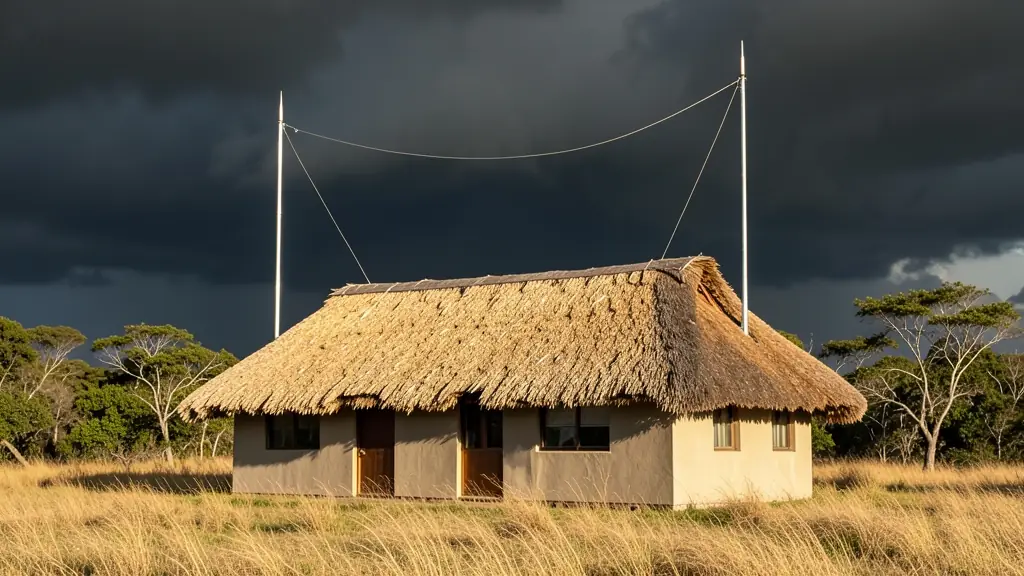
A thatched roof is dry grass on a timber frame, and a strike can set it alight in seconds. That is why lightning protection for thatch roofs works differently from a tiled house: nothing is fixed onto or through the thatch. The strike is caught by masts or a wire that stand clear of the roof and is taken down to earth well away from it. This page explains how isolated systems work, what separation means, what insurers usually ask for, how lapas and lodges are handled, and the faults installers find on older systems.
Isolated systems: masts and catenary wires
The common design is one or more free-standing lightning masts beside the building, taller than the ridge, so the whole roof sits inside the protected zone. On a long roof, a catenary wire is strung over the ridge between two masts, high enough that it never touches the grass. Each mast has its own down conductor, test clamp and earth electrodes, bonded to the house earth below ground. The down conductor runs down the mast or beside it, never across the roof.
Installers design these systems to SANS 10313 together with SANS 62305. Masts are sited so they stay clear of trees, driveways and the paths people use, and so a truck or crane can reach them when they go up.
Separation, and the metal near the roof
The designer calculates a separation distance between the mast or wire and the roof, so a strike cannot flash across to the thatch. Metal near the roof needs as much attention: gutters, chimney flues, a TV aerial on the gable, solar panels, satellite dishes, lights in the eaves and wiring in the roof space. Some of it should be moved, some bonded, and incoming services need surge protection so a surge cannot spark inside the roof.
Electrical wiring in a thatched roof space should be in conduit and kept well away from the grass, and the DB board should carry a surge arrester fitted by a registered electrician, who issues a CoC.
Insurers, lapas and lodges
Many insurers ask for a lightning protection system on thatched buildings, with a certificate from an accredited installer. Check your policy wording, since some also ask for regular inspections. Lapas, carports and thatched braai areas close to the house count too.
Lodges and bush camps in the Lowveld, the Waterberg and KwaZulu-Natal often have many thatched units spread across the property, so the installer plans masts unit by unit and quotes each one. A risk assessment helps decide the protection class.
Common faults on older systems
- Conductors fixed directly onto the thatch or run through it, a known fire risk
- Masts too short or too close to the roof
- Copper down conductors or earth leads stolen
- Corroded or loose joints and broken test clamps
- Solar panels, aerials or extensions added since the system was built
An inspection with continuity and earth tests finds these, and the report tells you what to fix first.
What to put in your request
- Roof length, width and ridge height in metres
- Number of thatched buildings, lapas and carports
- Metal near the roof: gutters, flues, aerials, solar
- Whether there is an old system and what it looks like
- Your insurer's requirements, if you have them in writing
Thatch Roof Lightning Protection for homes, thatch, estates, farms and industry
- Homeowners: a thatched family home where the insurer wants an isolated system and a certificate
- Thatched homes and lapas: masts or a catenary keep the strike and its heat away from the grass
- Estates and body corporates: thatched clubhouses, lapas and homes in estates where the body corporate sets the rules
- Offices, schools, churches and clinics: thatched restaurants, wedding chapels and conference venues
- Mines, plants, tanks and towers: thatched offices or canteens on plants and mines, tied into the site earth
- Farms and smallholdings: a thatched farmhouse or lapa on open ground where storms are frequent
- Lodges, guest houses and venues: many thatched chalets, a main lodge and a boma spread across a wide property
- Solar PV owners and installers: panels moved off the thatch or bonded with care, with masts covering the array
- Builders, engineers and electricians: masts and earths planned before thatching starts, so no metal goes into the roof
Frequently asked questions
Do you put up thatch lightning protection yourselves?
No. We are a free quote request service. We pass your request to independent installers who work on thatched buildings in your area, and they visit, design and quote you directly.
My system has a conductor running over the thatch. Is that a problem?
Very often, yes. A conductor fixed to or lying on the thatch can heat up or spark during a strike and ignite the grass. Most installers recommend replacing it with an isolated mast or catenary system. Ask for an inspection first so you know what you have.
Will my insurer accept any installer's certificate?
Not always. Many insurers want a certificate from an accredited installer, and ELPA accreditation is often what they have in mind. Check your policy or ask your broker before you choose an installer.
Is a thatched house a safe place to shelter in a storm?
A protected building is far safer than being outside, which is where most lightning deaths happen. Stay indoors until about 30 minutes after the last thunder, a common rule, and avoid baths, showers and corded equipment while the storm is overhead.
Thatch Roof Lightning Protection by province and city
- Johannesburg
- Pretoria
- Centurion
- Midrand
- Sandton
- Randburg
- Roodepoort
- Krugersdorp
- Randfontein
- Germiston
- Boksburg
- Benoni
- Kempton Park
- Alberton
- Vanderbijlpark
- Vereeniging
- Durban
- Pinetown
- Pietermaritzburg
- Richards Bay
- Newcastle
- Ladysmith
- Gqeberha (Port Elizabeth)
- East London
- Kariega (Uitenhage)
- Mthatha
- Cape Town
- Bellville
- Paarl
- Stellenbosch
- George
- Worcester
- eMalahleni (Witbank)
- Middelburg
- Secunda
- Mbombela (Nelspruit)
- Rustenburg
- Brits
- Klerksdorp
- Potchefstroom
- Mahikeng
- Polokwane
- Tzaneen
- Kimberley
- Upington
- Bloemfontein
- Welkom
- Sasolburg