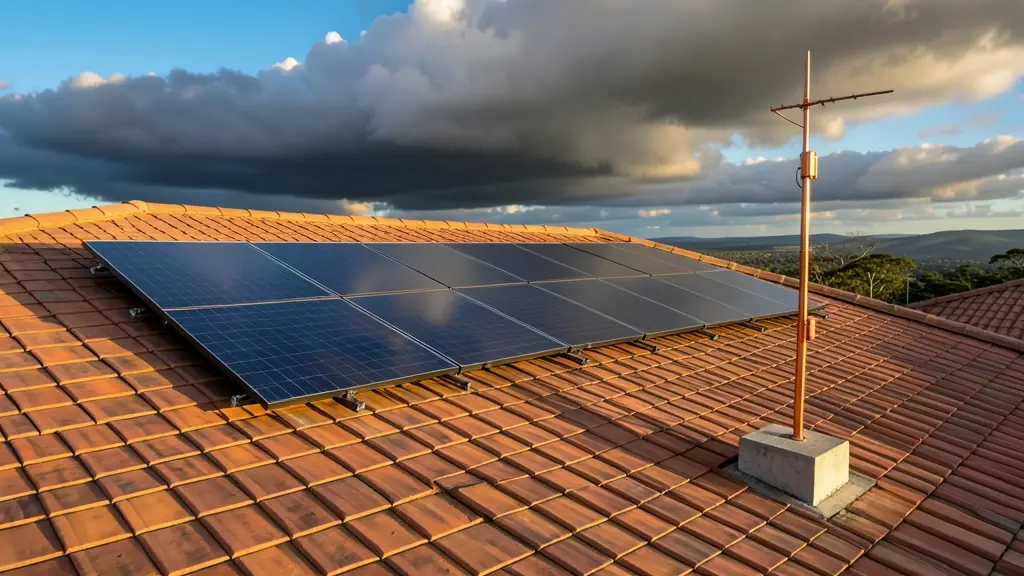
Solar panels add a large metal surface to the roof, cables that run from the roof to the inverter, and a battery bank worth more than most households want to lose. Lightning protection for solar panels covers the direct strike on the array and, far more often, the surges that travel down the DC cables or come in on the AC supply. This page explains how air terminals and separation work around an array, how frames and rails are bonded and earthed, where DC and AC surge devices go, how to protect the inverter and battery, and what paperwork to expect.
Air terminals and separation from the array
If the building already has an external system, the array must sit inside its protected zone. Air rods are placed so the rolling sphere does not touch the panels, at a separation distance so a strike on the rod cannot jump to the frames, and where they will not shade the panels. On thatch, panels need special care and are often better on a separate structure (see thatch roof lightning protection). Ground-mounted arrays on farms are often covered by lightning masts beside the rows.
If the building has no external system, the risk assessment decides whether the array needs one. Many suburban rooftop systems rely on bonding and surge devices alone, while exposed farm and commercial arrays more often get air terminals.
Bonding frames, rails and the earth
Panel frames and mounting rails are bonded together and to the building's earth. Where the array is kept separate from the lightning system, the bonding follows the design; where it cannot be separated, it is connected to the system. All earths, lightning, electrical, telecom and solar, should end up bonded into one earthing system, since separate earths at different voltages during a strike cause damage. See earthing materials for the cable, clamps and bars involved.
DC and AC surge devices
DC surge protective devices are rated for the string voltage and fitted in a combiner box near the array, at the inverter's DC input, or both on long cable runs. AC devices protect the inverter output and the DB board, with a Type 1+2 device at the main board where the building has an external system or an overhead supply line. Many have a window that changes colour when worn out. Follow the inverter maker's datasheet for ratings. See DC surge protection.
Inverter, battery and paperwork
The inverter and battery are usually the most valuable parts. Keep DC cables short, run positive and negative together to avoid large loops, and protect communication cables and any data lines too. The installation must be done or signed off by a registered electrician, who issues a CoC under SANS 10142-1. Ask for the surge device ratings in writing and when they should be checked. On the Highveld and in Limpopo, where summer storms are frequent, plan this with the solar design rather than after the first strike.
What to put in your request
- Array size in kW, number of strings and panels
- Inverter and battery type, and where they are
- Rooftop or ground-mounted, and the roof type
- Whether the building has a lightning system
- Cable distance from the array to the inverter
Solar Panel Lightning Protection for homes, thatch, estates, farms and industry
- Homeowners: a home system with panels, inverter and battery that should survive summer storms
- Thatched homes and lapas: panels moved off the thatch or onto a separate structure, covered by masts
- Estates and body corporates: rooftop arrays on units and clubhouses with protection set by the body corporate
- Offices, schools, churches and clinics: large rooftop arrays on offices, schools and shopping centres
- Mines, plants, tanks and towers: solar plants on factory roofs or ground arrays at mines and plants
- Farms and smallholdings: ground-mounted arrays powering borehole pumps, dairies and packhouses
- Lodges, guest houses and venues: off-grid or backup systems at remote lodges where a failed inverter means no power
- Solar PV owners and installers: installers adding DC and AC surge devices and bonding as part of every job
- Builders, engineers and electricians: surge devices, bonding points and cable routes planned with the solar design
Frequently asked questions
Do you install solar surge protection?
No. We are a free quote request service. We pass your request to independent solar installers, registered electricians and lightning protection installers in your area, who quote you directly.
Does my inverter already have surge protection?
Many inverters include some internal protection, but it is often limited. External DC and AC devices take the heavier surges and cost far less to replace than an inverter. Check the maker's datasheet and ask the installer what it covers.
Do solar panels attract lightning?
Panels do not draw storms to a house, but they add metal on the highest surface of the roof and long cables into the building. That changes the risk, so a protection plan should be part of the solar design.
What should I check after a storm?
Look at the surge device windows in the combiner box and DB board, check the inverter for fault alarms, and look for scorch marks on cables. If a device has changed colour or tripped, have an electrician replace it. Never open a DC combiner box yourself, since panels stay live in daylight.
Solar Panel Lightning Protection by province and city
- Johannesburg
- Pretoria
- Centurion
- Midrand
- Sandton
- Randburg
- Roodepoort
- Krugersdorp
- Randfontein
- Germiston
- Boksburg
- Benoni
- Kempton Park
- Alberton
- Vanderbijlpark
- Vereeniging
- Durban
- Pinetown
- Pietermaritzburg
- Richards Bay
- Newcastle
- Ladysmith
- Gqeberha (Port Elizabeth)
- East London
- Kariega (Uitenhage)
- Mthatha
- Cape Town
- Bellville
- Paarl
- Stellenbosch
- George
- Worcester
- eMalahleni (Witbank)
- Middelburg
- Secunda
- Mbombela (Nelspruit)
- Rustenburg
- Brits
- Klerksdorp
- Potchefstroom
- Mahikeng
- Polokwane
- Tzaneen
- Kimberley
- Upington
- Bloemfontein
- Welkom
- Sasolburg